
Trainer Handbook


Apprentice Training
The Trainer handbook has been designed as a tool for you to use throughout the training journey. It contains all the information you need to get started and make sure that your experience is a positive, challenging and rewarding one.
ACADEMY APPRENTICE TRAINING
An apprentice is an employee who learns a trade or profession while working for an employer under a formal training contract. This involves both on-the-job training and formal study with a Registered Training Organisation (RTO). Apprentices earn a wage and learn the trade!
As an RTO, we provide formal training to the apprentice. The employer mentors the apprentice while on the job.
There are 5 parties involved in an apprenticeship.
- Employer
- Apprentice
- AASN
- RTO
- DESBT
The RTO is only responsible for training, anything related outside of training can be navigated back to the employer, the AASN or DESBT.
Academy Apprentice Training
(Hours will depend on salon/Shop)
Full time – once a week or fortnightly.
Part time – once a month.
School-base – 6-8 weeks. (can only complete 40% of qualification while in school)
In Shop/Salon Training
Full time apprentice - Once a month for 2 hours (Hair and Barber) They can attend the academy as well as often as the shop/salon allow.
Part time apprentices - Once a month 2 hours (Hair and Barber)
School based apprentices - 6-8 weeks (can only complete 40% of qualification while in school)
Trainer required to contact apprentice and CC supervisor in a check in email every 2 weeks. It is the trianer responsibility to check in with apprentices if they are missing classes etc.
If they continue to miss classes and you have checked in with shop/apprentice and not heard back - flag in your trainer checklist.
Once you have been allocated as the trainer for an apprentice, you are responsible to follow up with apprentice and shop regarding all training and assessment contact.
Note: There are 3 types of apprenticeships
Full time: 3 years
Part time: 6 Years
School-based: Can only complete up to 33.3-40% of the qualification while in school.
The course is still competency based which means as long as ALL parties agree, the apprentice can be signed off earlier then their expected nominal completion date.
The department may request additional information for an early sign off - this information request may be diverted to the trainer to discuss.
There is no minimum hours an apprentice must complete to receive trade papers for their apprenticeship. However, cannot be signed off within 8 months.
Meaning of trade qualified: A trade qualification is documentation you receive once you complete adequate training for a trade profession. A trade qualification recognises employment-based training and formal education.
We the RTO provide the qualification, the QLD department issue the trade papers.
FURTHER INFORMATION REGARDING QLD APPRENTICESHIPS
ANYTHING SIGNED OFF UNDER 2 YEARS THE QLD DEPARTMENT WILL FLAG.
You cannot finish a barber apprenticeship within six months because traditional apprenticeships typically take 3 to 4 years to complete, and QLD law requires a minimum of eight months for a training contract to be legally recognized. While apprenticeships are competency-based and can be completed faster if all training is met, this is generally not feasible within a 6-12month timeframe for a full barber apprenticeship.
Apprenticeship duration: A typical barber apprenticeship in QLD takes between 3 and 4 years to complete.
Competency-based training: Although apprenticeships are competency-based, the skills and performance standards for a barber are usually not achievable in just 6 months.
Minimum legal requirement: The minimum legal time required for a training contract is eight months.
On-the-job training: Apprenticeships include extensive on-the-job training, and achieving the necessary practical experience to be considered fully qualified typically takes years.
You can be signed off on your barber apprenticeship in QLD earlier than the nominal completion date, which is typically 3-4 years, if you complete all training units and are deemed competent by your employer and RTO. To finalize the early completion, you must agree on a proposed date with your employer and submit Form ATF-052 to the Department of Education, Skills and Employment (DEET).
Key steps for early completion
Complete all competencies: Ensure you have successfully completed all the required units of competency in your training plan.
Demonstrate workplace competence: Your employer and registered training organization (RTO) must confirm you are competent in the workplace to industry standards.
Agree on a completion date: Discuss and agree on a proposed early completion date with your employer.
Submit the form: Complete the "Completion of an apprenticeship or traineeship" form (ATF-052).
Liaise with DEET: Submit the completed form and any required evidence to the DEET for processing.
Receive certificates: You will receive a qualification certificate from your RTO and a completion certificate from the DEET upon approval.
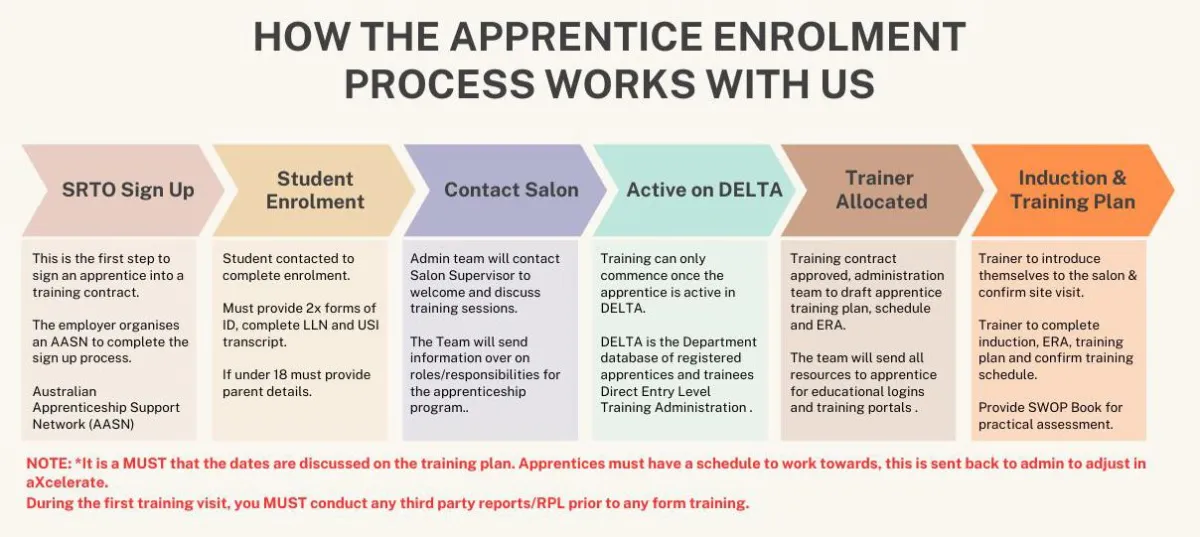
student induction/Allocation - apprentices
Our apprenticeship program is designed to be flexible. That means we offer in shop/salon training and academy training.
Training in shop/salon is once a month (every 4) weeks for 2 hr per student.
Apprentices can attend the academy in addition and as often as they like as long as the training is schedule and confirmed with the Team Leader/s.
In between in salon training visits, trainer will need to check in with apprentice every 2 weeks via email (set a reminder)
It is the trainer responsibility to ensure they complete all required paperwork, ERA and training plan and to confirm training schedule EVEN if they are attending the academy for training.
Step 1, Trainer Assigned to Apprentice
- Trainer receives Axe email ‘Assigned to Trainer’ from Administration team with Enrolment Checklist attached advising of completed enrolment. (Trainer can click on student name in email to directly open Axe contact page) NO training can commence until the student enrolment is complete and training contract is active with DELTA.
- Trainer should review Enrolment Form, LLN, Pre-Enrolment Interview and any file notes to familiarise themselves with the student.
- NOTE Apprentices: Student Services Officer will have contacted the salon/shop to schedule the first training session. It is up to the trainer on the first session to organise training sessions for the year and schedule into the trainer schedule. The students login details will have been sent at the time of allocation to trainer.
2. Welcome Call/Email
Call /Email student and salon and welcome to The Barber Academy/The Hair Academy and to the relevant qualification, advising them of the following:
- That you are their Trainer and that you will be able to assist them with any queries they have and will have organise regular face to face
contact/training with them. Confirm or make a booking for training session. (This might be in academy or salon training)
- Confirm correct student details are recorded (eg mobile, email, address etc.)
- Discuss the scheduled day/time that you will be conducting Induction (getting student set up on learner portal/Student Individual Learning Plan (SILP), ERA and meeting with student and supervisor. (In some cases the administration team may have organised the first visit with the employer and put in calendar. The above process still needs to be followed)
NOTE: For all Apprentices this meeting should also be arranged at a suitable time to include the employer and is to be conducted at the students’ workplace.
This first session will be added to your Trainer Schedule (TeamUp calendar)
Ask student if they have any questions.
Final welcome to The Academy and advise they will be receiving email/text confirmation of conversation and that they will be contacted as agreed.
REMEMBER to always communicate with the supervisor when in the salon/shop. All communication is to be recorded in the student profile.
NOTE: If student is long-distance, please organise phone/zoom sessions with apprentice to get them onto the portal and working through theory. Please discuss with employer face-face training (this is block training, they can either come to the academy or we can send a trainer out).
Step 3. INDUCTION - First Visit
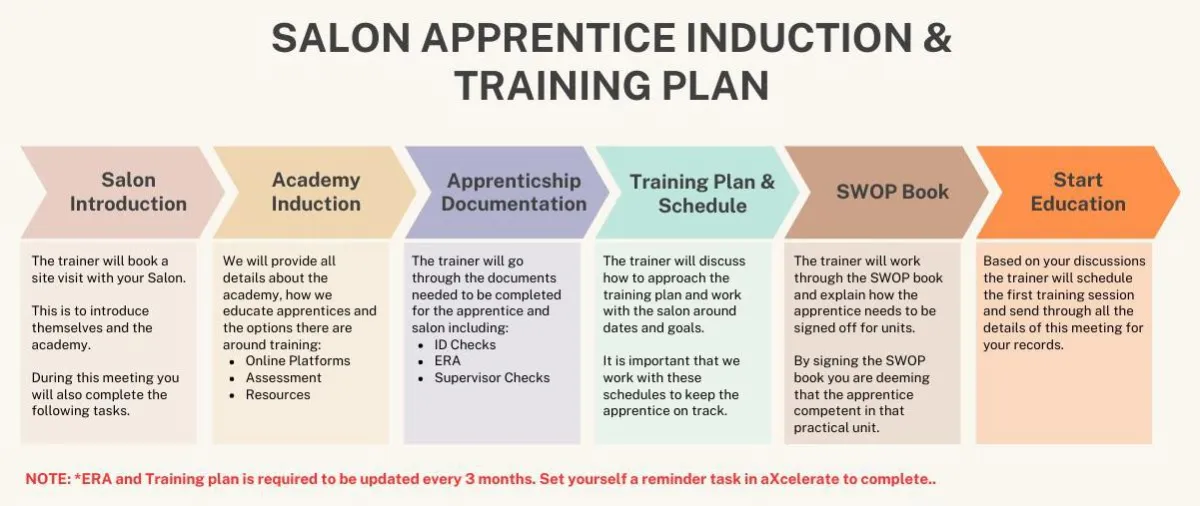
The first session will be to go over the induction - this is completing, the ERA, Training plan, training schedule, setting up online platforms, going through the SWOP book and theory components. (Ensure the supervisor is available at the time to discuss requirements etc.)
During this visit you MUST discuss the student's experience and confirm any eligible third party reports or RPL.
Confirm training schedule and put in the calendar.
TIP: Add Resource Note on student aXcelerate profile whenever they are provided resources (SWOP etc) This includes apprentices attending the academy.
After your first visit, contact the apprentice and employer with a follow up of the session using the template: Trainer Contact
Put in the relevant information.
EG.
Nice meeting you both today. As discussed, please see attached training schedule and expected unit start and end dates to work towards throughout your apprenticeship.
This email also is confirmation that you have received the following items:
|x| Login to aXcelerate
|x| The Hair and Barber Community access
|x| Student textbook
|x| SWOP Book
Our administration team will send through a copy of your sign training plan for your records. As you continue to progress throughout your apprenticeship, we will send through an updated training plan for your records.
If you have any questions or concerns please let me know.
A copy of the signed training plan and ERA must be given to the administration team for scanning and updating unit dates in the system.
Confirm the supervisor and request that they provide a copy of their qualification and send to administration team.
NOTE: If the shop/salon already has apprentices with us, they will most likely know the process. However, you must still follow the above induction steps to ensure the apprentice is set up and ready for training.
Set a reminder task to check in with apprentice in 2 weeks via email.
TRaining Plans
The administration team will prepare a DRAFT training plan and print off to give to trainer to take out on first visit. The trainer is required to discuss the training plan with both employer and apprentice to confirm any changes in elective units and put down estimate start and end dates for each unit.
The trainer must sit down with the employer and apprentice to discuss the training plan, dates must be put into place for the student to work towards their units.
This will give the apprentice/employer and idea of what is required for their apprenticeship and will give the apprentice deadlines to work towards.
Remember: The training plan must be signed and returned to the administration team to scan and send to all parties.
NOTE: IF the apprentice is long distance, training plan will be sent through the Axcelerate system for signatures by the
administration team. The requirements for digital signatures is that no parties are “typing” signatures, they MUST draw
their signature on the training plan or the department will reject the training plan. Trainer is to ensure the digital version
is signed at the first visit.
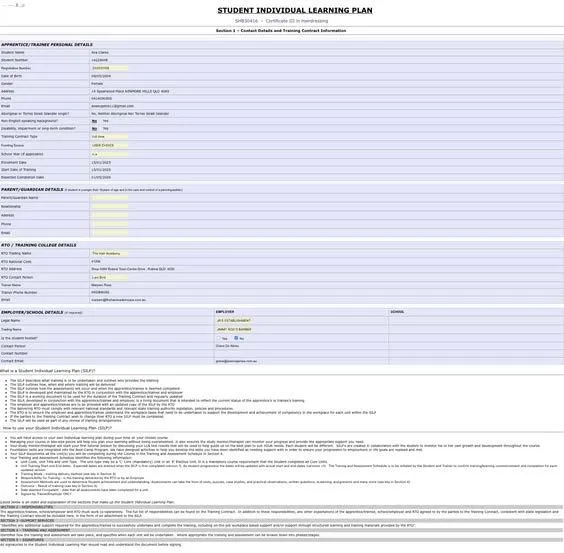


Training plans are required to be sent to apprentice and employer every 3 months. (No signatures required, set yourself a reminder for the 3 month followup)
In aXelerate on student profile
- Go to intake/qualification
- Click on Template
- Action plan - SILP Update
- Click Submit
- Complete the relevant fields
Reason for update - select OTHER
Comments - Updated training plan for apprentice and supervisor records
Conclusion - No action required
- Click Save and send. This will be emailed off the all parties and saved to student Axcelerate profile.
Set a reminder to update again in 3 months.
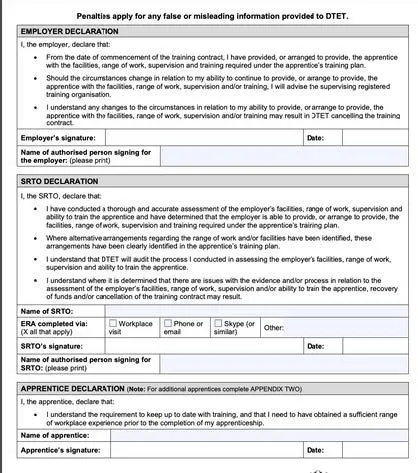
Employer resource assessment form ERA
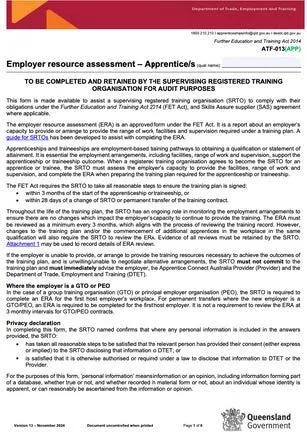
The employer resource assessment (ERA) is completed and retained by the supervising registered training organisation to verify that the
employer of an apprentice or trainee is able to provide, or arrange to provide, the facilities, range of work and supervision required under the training plan.
This document is to be discussed and completed during the first visit. Apprentices are required to at all times have a qualified supervisor
overseeing them during work hours and the salon/shop is required to have appropriate facilities for the apprentice to complete their
qualification.
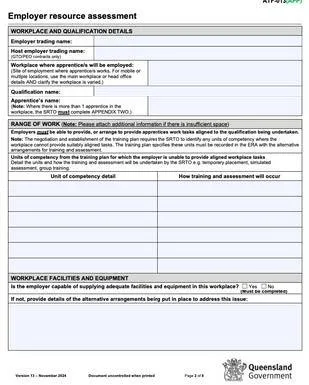
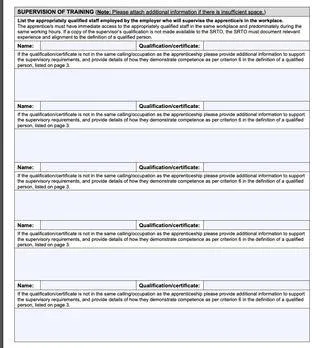
On the ERA document, we need to identify the qualified supervisor that will be overseeing/mentoring the apprentice in the workplace. We also need to indicate if the workplace has the require facilities to complete their qualifications and if not, what other arrangements need to made.
Example: An apprentice is doing Certificate III in Barbering and in the shop, you notice there is no basin, we need to indicate this on the ERA and put down alternative training methods such as an apprentice attending an academy for training for that unit.
On page 2 of the ERA - we would need to indicate. Shop does not have basin and student can attend academy to complete SHBHBAS001 OR
we can provide a simulation exercise in the workplace and ask competency questions to address the training package requirements for that
unit.
The Administration team will print off the ERA form to give to trainer for the first training visit to complete. All information on this form is
required to be completed and signed by all parties.
Please complete and provide a scanned/photo of the completed ERA to the administration team and keep the hard copy file with
you to update quarterly.
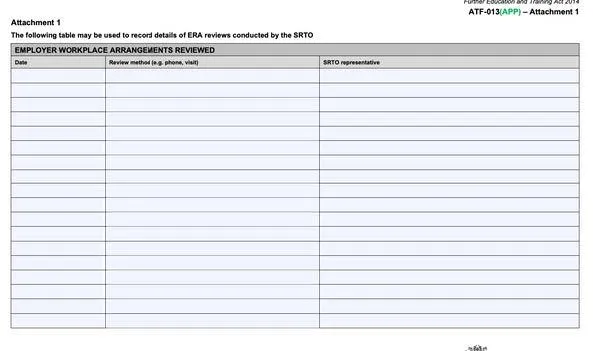
The ERA must be updated everything 3 months! Please ensure you set yourself a reminder to update ERA every 3 months.
On the last page of the form, is a section to update the ERA quarterly.
If there are any issues with supervisors in the workplace, please contact the administration team immediately.
Once the document has been completed and a new one required, please provide the administration team the old ERA and collect a new ERA.
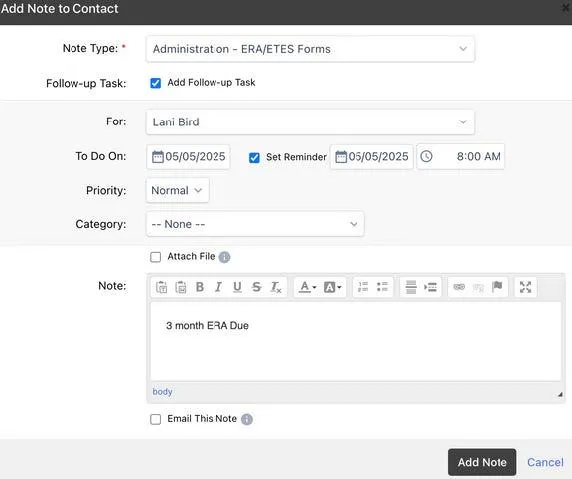
To set a reminder for the quarterly update on ERA;
Go to student profile.
- Add Note
- Note Type: Administration - ERA/ETES Forms
- Click add follow-up task
- Click on: TO DO and update date for 3 months and click SET REMINDER
- Add in note section: ERA due
- Add note
A reminder email will be sent to you on the date set to action ERA update.
In Queensland (QLD), a supervisor can only supervise an apprentice if they meet specific criteria, and an international certificate alone likely won't be sufficient.
Generally, supervisors must have completed an Australian apprenticeship in the relevant trade, hold a certificate of recognition, be a qualified Australian tradesperson, or have relevant qualifications as outlined by Business Queensland.
The supervisor of an apprentice Barber must have a Certificate III in Hairdressing and/or an old Barbering qualification, with proven experience with men’s haircuts. Longer term, the holders of Certificate III in Hairdressing should be aiming to add shaving and other 'Barber-focused units' to their qualifications to supervise apprentice Barbers. The Department of Employment, Small Business and Training will continue to monitor supervisors of barbering apprenticeships.
Employers are required to provide, or arrange to provide the facilities, range of work, supervision and training as detailed in the training plan.
In Queensland, to supervise a barber apprentice, you generally need to hold a Certificate III in Hairdressing and/or an old Barbering qualification, with proven experience in men's haircuts. Ideally, individuals with a Certificate III in Hairdressing should also aim to add Barbering focused units (like shaving) to their qualifications. Additionally, a person who has completed an apprenticeship in barbering with a completion certificate or holds a certificate of recognition, or is an Australian tradesperson in the barbering field, may also be eligible.
Apprentices MUST be supervisor during work hours by the nominated qualified supervisor.
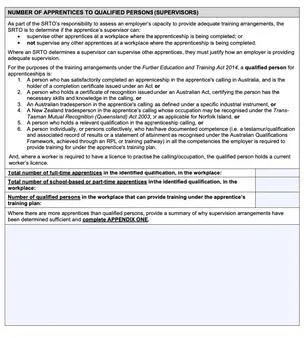
Qualified person for apprenticeships
1. A person who has satisfactorily completed an apprenticeship in the apprentice's calling in Australia, and is the holder of a completion certificate issued under an Act, or
2. A person who holds a certificate of recognition issued under an Australian Act, certifying the person has the necessary skills and knowledge in the calling, or
3. An Australian tradesperson in the apprentice's calling, as defined under a specific industrial instrument, or
4. A New Zealand tradesperson in the apprentice's calling whose occupation may be recognised under the Trans-Tasman Mutual Recognition (Queensland) Act 2003, or
5. A person who holds a relevant qualification in the apprenticeship calling, or
6. A person individually, or persons collectively, who has/have documented competence (i.e. a testamur/qualification and associated record of results or a statement of attainment as recognised under the Australian Qualifications Framework, achieved through an RPL or training pathway) in all the competencies the employer is required to provide training for under the apprentice's training plan.
And, where a worker is required to have a licence to practice the calling/occupation, the qualified person holds a current workers licence.
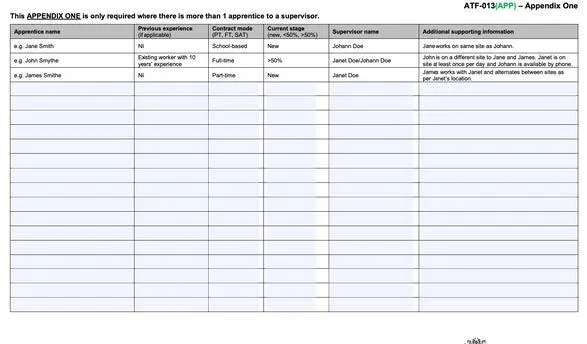
While there is no set ratio required for the number of supervisors to apprentices or trainees it is generally accepted for apprenticeships there is one supervisor to each apprentice, this may be relaxed as an apprentice gains skills and experience or where an apprentice commences with existing skills and experience.
Adequate supervision of apprentices and trainees cannot solely be provided from an offsite location by electronic means. Electronic means include, but are not limited to, telephones, radios and webcams.
The level of supervision will normally range between direct, general and broad as per the below guidelines:
- Direct - Close monitoring of work ensuring understanding and identifying potential risks and/or hazards
- General - Occasional monitoring to ensure progress is occurring
- Broad - Quality checking of completed tasks.
SUPERVISOR WORKPLACE INSTRUCTIONS
The Hair Academy and The Barber Academy would like to thank you for choosing to partner with us in the Apprenticeship Program. We believe that the experience of your supervising staff and the environment that you provide, alongside our Trainers will provide a great creative experience for your apprentice(s). Your involvement in this process will assist your apprentice’ to gain hands on industry experience and skills in the Hairdressing Industry.
Within this Information Pack you will be informed of your rights and responsibilities in relation to the Partnership between you, the apprentice and The Hair Academy and The Barber Academy. We will also provide you with an overview of what we expect of from you whilst in your salon. Please be sure to read all this information thoroughly as it is crucial to ensuring you and the apprentice have the best experience possible.
How will my Salon/Shop benefit?
Through your active involvement in this Partnership, you will:
1. Benefit by having not only an extra pair of hands, but hands that contribute to the effective running of the salon to share the workload in the day-to-day tasks carried out within your salon.
2.Contribute to increasing the skills and knowledge of up-and-coming stylists in the industry.
3.Provide your existing employees with an opportunity to attend Master Classes run by The Hair Academy and The Barber Academy, providing an opportunity to further enhance your staffs’ skills.
4. Benefit by having a say in what skills or units apprentices learn in order of preference.
5.Benefit from having a close working relationship with the Trainer assigned to your apprentice.
6.Benefit from regular progress reports on the apprentice.
7.Benefit from a new way of learning for the apprentice, keeping them motivated and on track to complete their apprenticeship on time.
The Trainer - The Hair Academy and The Barber Academy
The Hair and Barber Academy Trainer is responsible for ensuring salon suitability checks. This is to ensure the salon has ALL the resources
needed for the Apprentice to complete their Qualification.
An example of this would be if a salon doesn’t perform any permanent wave services or basin services. In this case, the Trainer would
investigate other ways of ensuring the Apprentice has access to these resources. This could be by providing the salon with resources, or
completing certain units in a ‘Host Salon’ The Trainer organises the relevant documentation to ensure suitability checks are completed prior to training taking place.
The Salon Supervisor
The individual who will supervise the apprentice within your salon.They must hold the necessary qualifications (equivalent to or higher than the qualification that the Apprentice is currently undertaking).The Salon Supervisor will be nominated by the Salon Owner.
The Supervisor facilitates opportunities for the Apprentice to gain valuable workplace and industry skills and experience and is responsible for observing the successful completion of the tasks outlined within the Apprentice Skills Workplace Observation Portfolio (SWOP).
The Apprentice
Is responsible for working alongside the chosen Salon Supervisor and has a requirement to complete all the practical tasks as outlined in their Apprentice Skills Workplace Observation Portfolio (SWOP).
Before starting Salon Training
Prior to starting their salon training The Hair Academy and The Barber Academy will have to complete the following checks as stated by the Department of Employment, Small Business and Training (DESBT):
1. Complete a Salon Suitability Check (to ensure all required resources are available)
2. Review the Apprentice’s Training Plan with the salon and the Apprentice. To ensure the Apprentice will complete training of units in an order beneficial to both the Apprentice and the Salon.
3. Agree with both the Salon and Apprentice the desired day for training. This is usually 2 hours of training once a month for a full-time/part-time Apprentices in salon training. Please be aware that we can adjust hours depending on the needs of theSalon owner and Apprentice needs which may change over time. We also offer inacademy training (training days/hours can be organised with the supervisor andtrainer.)
4. Induction date confirmed with Trainer and assigned Salon Supervisor and Salon Owner.
TRaining participation log
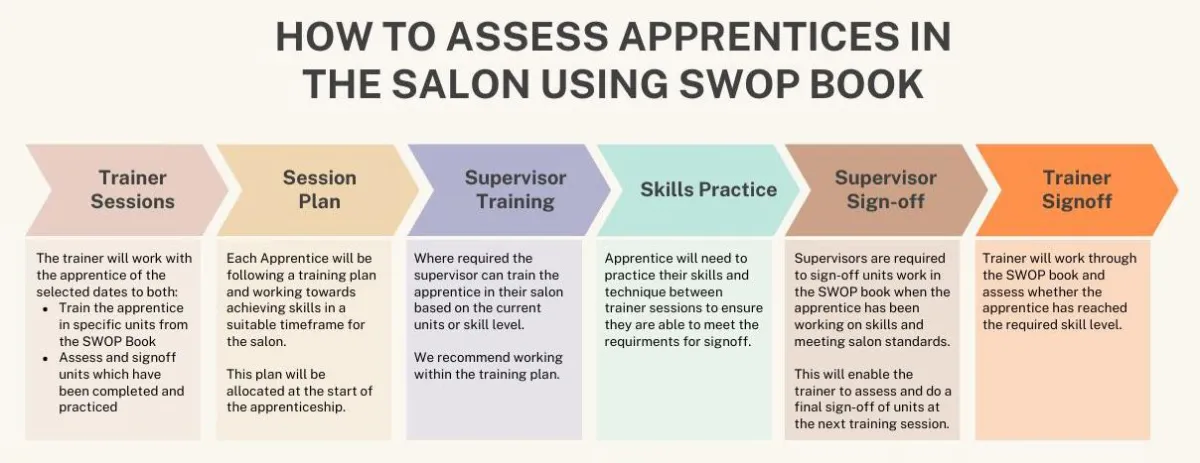
Apprentices and Certificate II students (IN SWOP BOOK)
In the front of the SWOP book, there is a training participation log section that must be completed when a trainer visits the shop/salon for training.
The SWOP book must stay in the shop/salon. If apprentices are attending the academy for training, they must bring in their SWOP book to each training session and take it back to the employer.
The training log MUST be completed below the below checklist:
* Unit of competency code and title
* Date of training
* Duration of training
* Location of training (internal - postcode of delivery, workplace - post of delivery - External - Postcode of co-ordination)
* Student Identification - MUST sign the participation log. IF online, student MUST fill in training log and send photo to trainer to upload to their records. Trainer is required to record online session as evidence. NOTE: Trainer can use the template "Record of contact - Signature"
* Trainer must complete their full name, date, how long session was and signature in the training log.
* Ensure contact notes/non-attendance completed
Practical observations cannot be put through without all required signatures and the observation must be marked off correctly or it will be marked as “Unsatisfactory”
Note: The process is the same per the previous mentioned on signing practical observations. The only difference is we MUST have the supervsisor signature and the below log is completed.
Trainer must collect the SWOP book if the apprentices withdraw or completes. Issuance can not be processed with the SWOP book.
Apprenticeship RPL process
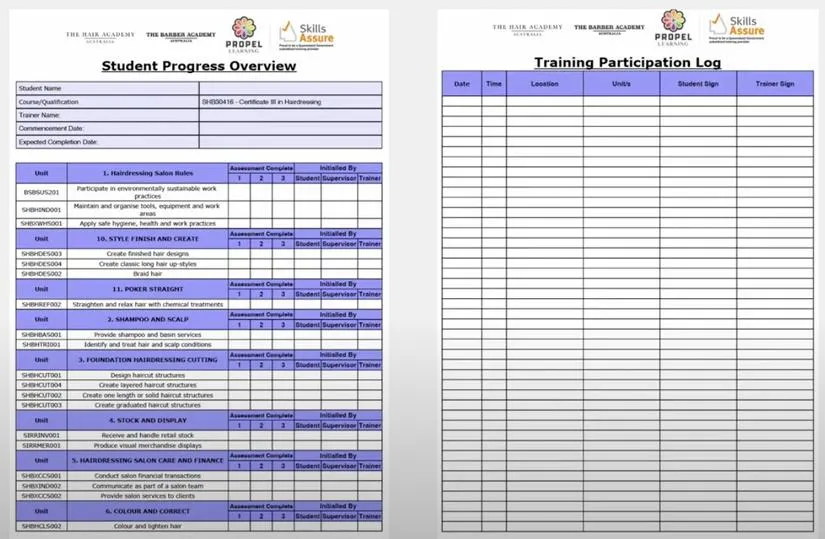
An apprentice can use Recognition of Prior Learning (RPL) to gain formal qualifications faster by demonstrating existing skills and knowledge gained from work or life experiences. RPL identifies skills the apprentice already possesses, allowing them to bypass redundant training modules and expedite the certification process. To be eligible, individuals must provide evidence of competency, which may include resumes, training records, and practical demonstrations.
How RPL Works for Apprentices
Identify Existing Competencies:
An RPL assessment evaluates the apprentice's skills, knowledge, and experience against the required competencies for the qualification.
Validate Skills:
The assessment uses various forms of evidence, such as past work, on-the-job training records, project portfolios, and practical tasks, to demonstrate existing expertise.
Streamline Training:
Based on the assessment, the training provider can grant credit for certain units, allowing the apprentice to complete their qualification in a shorter timeframe.
Evidence for RPL
To support an RPL claim, you may need to provide evidence such as: Resumes and position descriptions, Letters of offer or contracts, Records of prior formal training or education, Photographs or videos of practical work, and References from employers or supervisors.
Benefits of Using RPL
Reduced Training Time: RPL can significantly shorten the duration of an apprenticeship or traineeship.
Cost Savings: Bypassing unnecessary training modules can reduce overall course costs.
Career Advancement: It allows apprentices to achieve formal, nationally recognized qualifications more quickly, opening up new opportunities.
RPL is completed at the same time you would a third party when you are signing the training plan.
These apprentices are the ones who have a lot of prior knowledge and skills maybe come from a previous shop where the previous RTO didn’t sign them off for anything. An apprentice who has come from overseas with skills in certain units. It is not our intention to complete a full RPL as that wouldn’t be appropriate and if that were the case you would direct them to another form of study.
Note: The experience cannot be from the same shop they are in now. It must be prior experience.
Use https://training.gov.au/ to check the units.
Every apprentice is different but usually an RPL or third party wouldn’t exceed 1/3 of the qualification.
1. Awareness & Pre-enrolment Review
Inform apprentices of RPL availability. Conduct an initial suitability review (skills, context).
2. Application
Apprentice submits RPL application (units specified, with supporting evidence overview).
3. Evidence Gathering
Collection aligned with the principles of evidence. Provide evidence guides and optional support.
4. Competency Conversation
Structured discussion to clarify and supplement submitted evidence.
5. Practical Assessment SWOP
Conduct practical tasks and or portfolio when evidence is insufficient.
6. Assessment Decision
Assessor applies fair, valid, reliable, and flexible judgment, documented clearly.
7. Feedback & Appeals
Provide detailed feedback. Offer clear appeal routes, complying with Standards 2.7 & 2.8.
8. Validation & Moderation
Periodic internal and external moderation/validation of RPL decisions and tools.
9. Continuous Improvement
Use data, complaints, audit results to refine RPL workflows and tools.
Changes to Training Contract
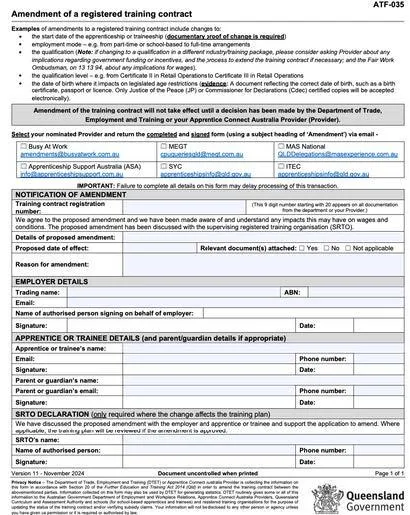
Apprentices that need to make changes to their training contract may include their work hours.
The DESBT Amendment of a registered training contract form must be completed.
If you have been made of aware of any changes to an apprentice training contract, please add this to your trainer checklist.
Team leader will discuss this with the administration team to organise a “Amendment of a registered training contract” form to be completed and lodge with the department.
Administration will organise to complete this form and send off via DocUSign or print off for signatures.
Once all parties have signed, the form will be lodged for approval by the department.
Once the application has been approved, the administration team will receive a notification with the updated expected completion date.
The Administration team will organise a new training plan to reflect the changes and print off for the trainer to take out to the shop/salon for signatures.
Trainer is required to have all parties sign new training plan and give back to administration team for scanning and filing.
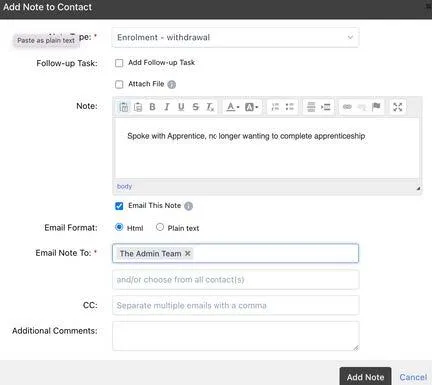
If an apprentice has withdrawn/cancelled their apprenticeship, please collect the SWOP
book and notify the administration team & team leader to process cancellation.
Transferring Employers/Shops/salon
Apprentices sometimes change employers, they can still stay with the RTO.
If you have been made aware an apprentice is going to a new employer and they are staying with the RTO note this in your trainer checklist.
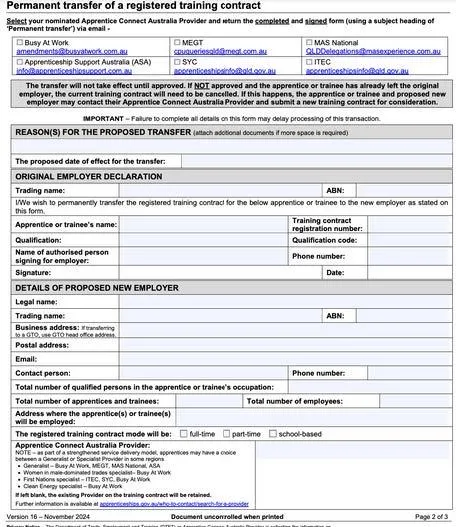
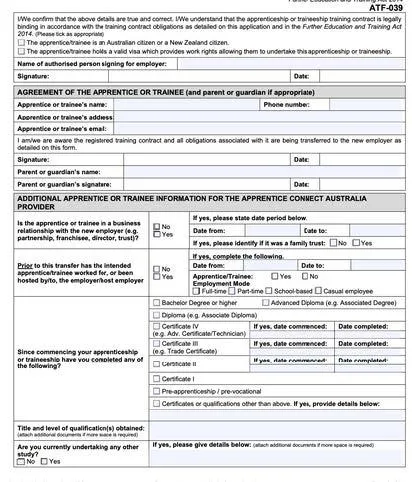
Team leader will notify administration team to process “Permanent transfer of a registered training contract” This will be printed or sent via DocUsign for signatures.
The employer and old employer (if possible), apprentice and RTO will need to complete the “Permanent transfer of a registered training contract” This form is updating the training contract from old employer details to new employer
details. Once all parties have signed, the form will be lodged with the department to make the relevant changes.
When the approval comes through, the administration team will organise a training plan and ERA. Both forms will be printed for the trainer to complete the induction with the new employer going over the training plan and ERA and collecting supervisor qualifications.
Please provide the signed training plan and ERA/qualifications to administration team for scanning and filling.
APPRENtICE completion process
Apprentice
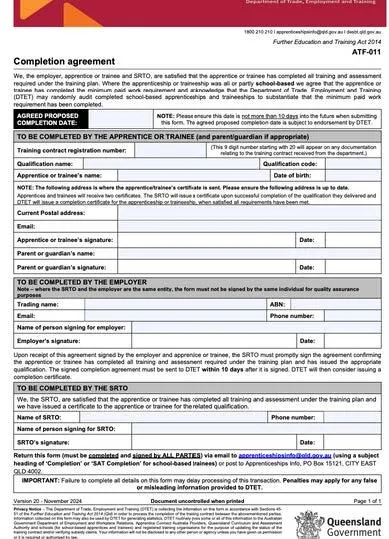
When an apprentice is ready for completion, please notify the administration team via email OR add to your trainer checklist in order for the administration team to prepare the DESBT completion agreement form.
The administration team will prepare the DESBT completion form and either print off for the trainer to take out for signatures OR send via DocUsign. IF printed, please ensure all fields are completed, dated and signed. Provide the administration team the completed form for lodgement along with the students SWOP book to prepare for issuance.
NOTE: We CANNOT sign off an apprentice without the supervisor agreeing to do so.
All practical observations must be signed by the supervisor and they must agree to sign the apprentice off.
Trainer must collect the SWOP book if the apprentices completes. Issuance can not be processed with the SWOP book.
Apprentice extension
Apprentices may require additional time to complete their apprenticeship.
This must be discussed with both the apprentice and supervisor, with all parties agreeing to apply for an extension with an expected end date.
There must be an action plan in place to apply for an extension with the department.
Step 1. If you are aware apprentice may require additional training to complete their apprenticeship, discuss this with the supervisor and apprentice with an idea of how long and what plan we can put into place to ensure completion.
Step 2. Add this concern into your trainer checklist
Step 3. Put together an action plan (using the student progress overview template)
Step 4. Save to Student profile under - Trainer - Student Progress Report
From here, the administration team, will be notified by Team Leader that an extension is required to be lodged.
The Administration team will put together the form (they may reach out to trainer to discuss) and send via DocUsign for signatures OR print off for trainer to take out next visit.
Once all parties have signed the extension form -the administration team will lodge the form and student progress report to the department for review.
Note: The department may call apprentice/supervisor/trainer to discuss the extension application.
Once the extension application has been approved, the administration team will receive a notification with the updated expected completion date.




COMPANY
COURSES
RTO#41209
FOLLOW US ONLINE



Copyright 2026. Propel Education and Training Pty Ltd - RTO #41209. All Rights Reserved.